
Summary first:
-
Reliable precision metal manufacturing in New England requires evaluating a provider’s certifications, in-house capabilities, and industry experience before committing to a project.
-
Shops that handle fabrication, forming, heat treating, and engineering under one roof reduce lead times and quality risk.
-
Verified certifications such as ISO 9001:2015 and AS9100D are the clearest indicators of process discipline in this region.
Finding a trustworthy precision metal manufacturer in New England means looking beyond price to confirm that a shop can hold tight tolerances, manage complex materials, and deliver repeatable results across production runs. The region has a well-established base of metalforming companies, and knowing what separates a capable partner from an average vendor makes the sourcing decision much easier.
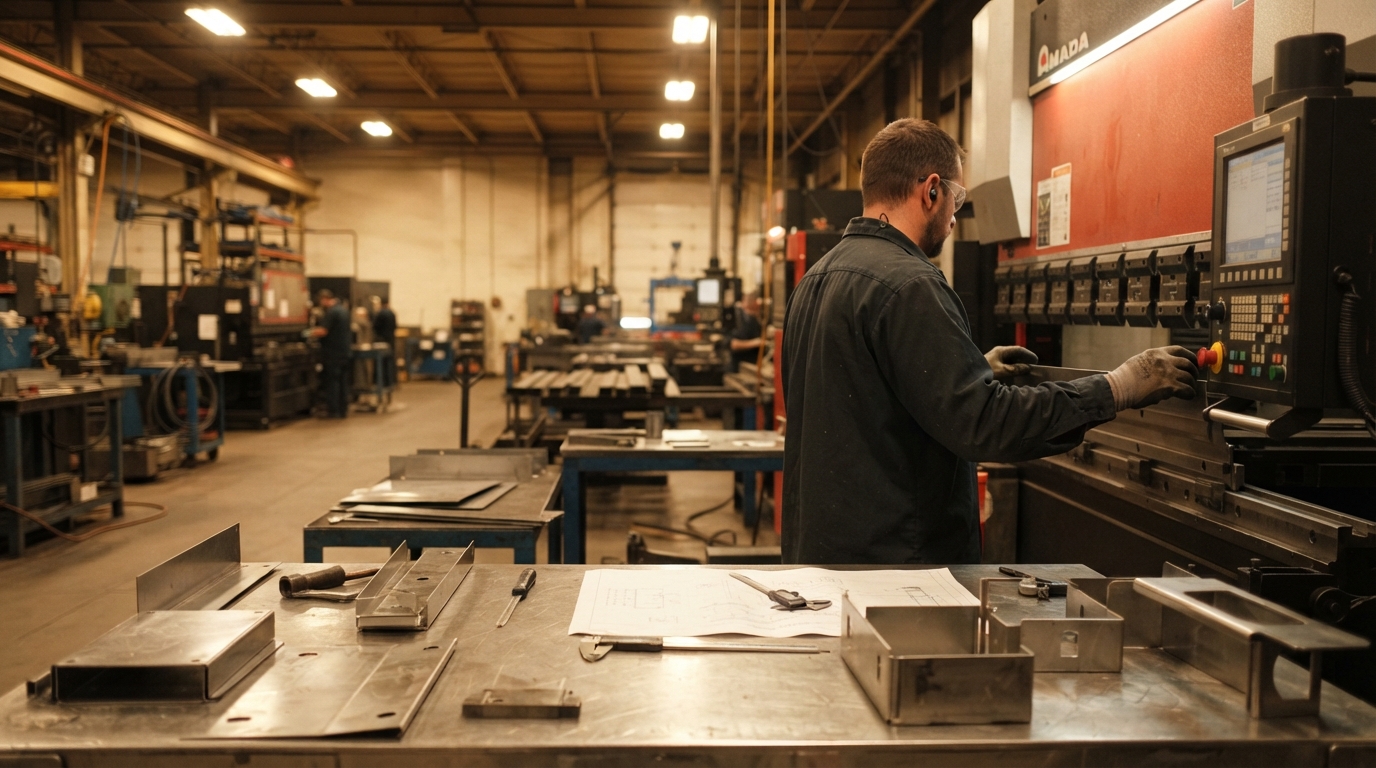
When evaluating Precision Metal Manufacturing in New England, ND, the first question to ask is whether a shop controls its critical processes in-house. Production and quality engineering teams should monitor every aspect of a production order, and the best shops strive to keep as many operations as possible under one roof. Outsourcing key steps like heat treating or laser cutting to third parties introduces scheduling risk and potential quality gaps.
What Core Capabilities to Look For
A full-service precision metal shop in New England should offer more than basic cutting and bending. The capabilities that matter most for demanding applications include:
-
Laser cutting and machining – 5-axis laser systems handle complex geometries that flat-bed cutters cannot reach.
-
Precision forming and hydroforming – Hydroforming is a process that offers many benefits over traditional sheet metal forming; in most applications, only one form tool is needed, which pushes a piece of sheet metal into a pressurized rubber bladder.
-
Vacuum and hydrogen heat treating – On-site furnaces eliminate the need for an outside vendor and protect material integrity.
-
CNC machining and tool design – Custom tooling produced in-house supports both prototype and production work.
-
Engineering consultation – Staff engineers who can review designs before production catch tolerance problems early.
State-of-the-art machinery allows leading shops to work with materials such as aluminum, brass, copper, Hastelloy, low carbon steel, stainless steel, and tantalum while holding the tightest of tolerances. Material range is a practical test of a shop’s equipment depth and operator experience.
Certifications That Signal Process Reliability
Certifications are not just paperwork. They demonstrate that a manufacturer follows documented, audited procedures that produce consistent output. The two most relevant standards for New England precision metal shops serving industrial clients are:
|
Certification |
Scope |
Why It Matters |
|
ISO 9001:2015 |
General quality management |
Confirms repeatable process control across all operations |
|
AS9100D |
Aerospace quality management |
Required by most aerospace and defense supply chains |
|
ITAR Registration |
Defense trade compliance |
Needed for components used in U.S. defense applications |
MuShield was the first in the magnetic shielding industry to be ISO 9001 certified, and with its latest ISO 9001:2015 and AS9100D certifications, manufacturing operations are reliable, repeatable, and efficient.
The Precision Metalforming Association (PMA) New England District has an active base of metalforming company members in and around Massachusetts, Maine, New Hampshire, Rhode Island, and Vermont, and membership in organizations like the PMA New England District is another signal that a shop stays current with industry standards and workforce development.
Evaluating a Vendor’s Industry Experience
Experience in specific end markets matters because tolerance requirements, documentation standards, and material specifications vary significantly by sector. A shop that serves aerospace, medical, and defense clients has already been vetted by some of the most demanding quality systems in manufacturing.
Leading precision metal manufacturers in this region offer services including precision sheet metal fabrication, hydroforming, research and development, engineering, welding, machining, tool design, metal spinning, consulting, and vacuum heat treating. That breadth of capability signals a shop that has grown alongside its customers’ requirements rather than staying narrowly specialized.
Prototype flexibility is also worth confirming. No job should be too big or too small — the best shops are equipped to make one-piece prototypes or handle mature production runs. A vendor that requires large minimum order quantities before engaging on a new design is not well-suited to development-stage projects.
Frequently Asked Questions
What materials are commonly processed by precision metal manufacturers in New England? Common materials include magnetic shielding alloys per ASTM A753, aluminum, stainless steel, tool steels, tungsten, Inconel, copper, tantalum, brass, and plastics.
Why does in-house heat treating matter? On-site vacuum and hydrogen furnaces are used for both in-process stress relief annealing and final heat treatment, which ensures maximum material performance. This eliminates the need to source fabrication and heat treatment from separate vendors.
What is hydroforming and when is it preferred? Hydroforming is a precision sheet metal process used to manufacture seamless components and complex formed parts for aerospace, defense, medical, electronics, utility, and scientific industries.
How do I verify a shop’s quality system before placing an order? Ask for copies of current ISO and AS9100D certificates, request a facility tour, and review their inspection process for incoming materials and finished parts. Certification bodies publish registrant directories that allow independent verification.
Choosing a precision metal manufacturing partner in New England is ultimately about risk reduction. Shops with documented certifications, broad in-house capabilities, and cross-industry experience give engineering and procurement teams the confidence that parts will arrive on spec and on time. The MuShield Company, based in Londonderry, New Hampshire, is one established example of a full-service precision metal manufacturer in the region offering magnetic shielding, precision sheet metal fabrication, hydroforming, and on-site heat treating for aerospace, defense, and medical clients.