
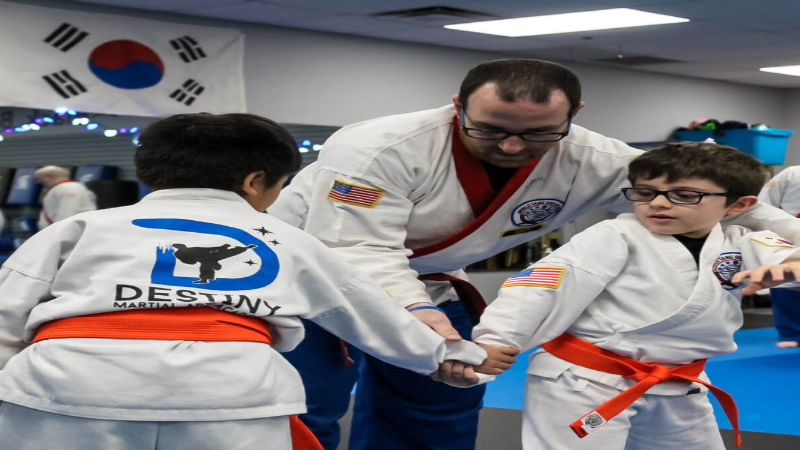
Young martial arts students practice stances first because stable body positioning supports nearly every technique that follows. A strong stance helps children control balance, direction, weight transfer, and movement before they begin combining punches, blocks, kicks, and transitions.
In youth karate, stance work may look simple compared with faster techniques, but it plays an important role in how students learn to move with control. For children training in Peoria, AZ, these fundamentals can create a more organized framework for learning increasingly complex movements over time.
What Is a Martial Arts Stance?
A stance is the way a martial arts student positions their feet, legs, hips, and body to prepare for or perform a technique.
Different stances can serve different purposes. Some may provide a stable base for a hand technique, while others help students move forward, backward, or change direction. The exact position matters because the rest of the body relies on the lower body for support.
For children learning karate martial arts, understanding where to place their feet is often easier than trying to coordinate an entire combination at once. Instructors can first establish the base, then introduce additional movements once the student becomes more comfortable.
Why Does Balance Come Before More Complicated Techniques?
Balance affects nearly every movement in martial arts.
If a student is unstable before beginning a technique, adding a punch or kick can make that instability more noticeable. A child might lean too far forward, shift too much weight onto one foot, or lose control when trying to change direction.
Practicing stances allows students to work on these issues without having to process several movements simultaneously.
This is particularly useful in martial arts for kids, where instruction is often broken into manageable parts. Students may first learn where to stand, then how to move from that position, and eventually how to connect the stance with a specific technique.
How Do Stances Help With Weight Transfer?
Martial arts techniques often require the body to shift weight from one leg to another.
That movement may happen during a step, turn, strike, block, or kick. If students do not understand how their weight is distributed, the transition can become awkward or unstable.
Stance practice gives young students time to notice whether their weight is centered, too far forward, or too far back.
Once they understand that relationship, more advanced movements can become easier to organize. Instead of thinking only about what their arms or legs are doing, students begin to understand how the entire body contributes to a technique.
Why Is Foot Position Important in Karate Classes?
Foot position determines more than where a student stands.
It can influence balance, movement direction, posture, and the student’s ability to continue into the next technique. If the feet are positioned poorly, the student may have to make an extra adjustment before moving again.
During karate classes, instructors may repeatedly correct foot placement because small changes at the base can affect the rest of the movement.
For younger students, repetition helps make those positions more familiar. Over time, they may need fewer reminders because the stance begins to feel more natural.
How Do Stances Support Punches and Blocks?
Hand techniques depend on a stable base.
A student who throws a punch while standing without proper balance may twist excessively, lean forward, or lose their position after the movement. The same can happen with blocks if the lower body does not provide enough support.
By starting with stance practice, students can learn to keep their body organized while the arms move independently.
This is one reason foundational training remains important even as students gain experience. The stance may not be the most noticeable part of a technique, but it influences how effectively the student can perform and recover from that movement.
Programs such as youth karate training can gradually build on these fundamentals as students become ready for more detailed combinations and movement patterns.
Why Do Kicks Depend So Much on Good Stance Work?
Kicks place even greater demands on balance because one foot temporarily leaves the ground.
Before a student can control the kicking leg, the supporting leg must remain stable. The student also needs enough body control to lift the leg, extend the technique, and return to a balanced position.
If the starting stance is inconsistent, the kick may become harder to control.
This is why martial arts karate instruction often spends time on basic positioning before expecting students to perform complex kicking combinations. The stance gives the student a reliable starting point.
How Do Stances Help Students Learn Combinations?
A combination involves several movements performed in sequence.
Students might need to step, block, strike, turn, or kick without stopping between each action. To do this successfully, the end of one movement must place the body in a useful position for the next.
Stance practice helps students understand those transitions.
Instead of treating each technique as an isolated movement, they begin to see how one position leads into another. This can make combinations smoother and reduce unnecessary repositioning.
Why Should Young Students Avoid Rushing Through Stance Practice?
Children may naturally be more interested in faster or more dynamic movements, but skipping foundational stance work can make later techniques harder to learn.
A student who has not developed consistent positioning may struggle when several movements are combined. They may remember the sequence but still have difficulty maintaining balance or controlling direction.
Slowing down gives students a chance to understand what their body is doing.
For young students in Peoria, AZ, this type of structured progression can make martial arts instruction easier to follow because each new movement builds on something already practiced.
How Do Stances Prepare Students for More Advanced Training?
As students progress, they are asked to manage more information at once.
They may need to think about distance, direction, timing, hand position, foot placement, and balance during the same exercise. Strong stance fundamentals reduce the number of basic corrections they have to make while learning something new.
That is why stance practice is not simply an introductory exercise. It remains relevant as techniques become more complex.
Young martial arts students who develop a stable foundation can more easily focus on how movements connect, how their weight shifts, and how to maintain control throughout a sequence. In karate and other martial arts training, learning where and how to stand is often the first step toward learning how to move well.